



 03.03.2026
 Read Time:
15 minutes
Read Time:
15 minutes



What is the nature of the attack on Iran and how could the situation evolve?
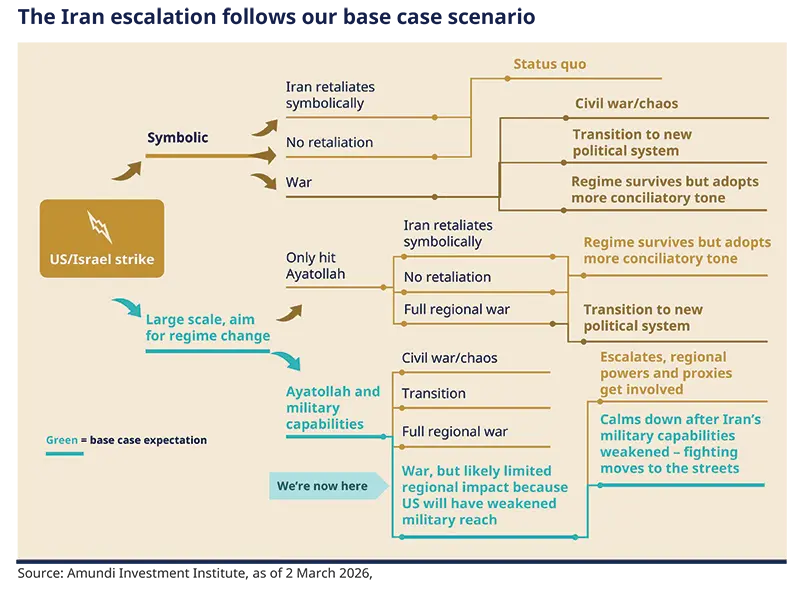
Nature of the shock – The US and Israel hit Iran in a large-scale attack, aimed at the Ayatollah, regime infrastructure, and military targets. We think this is a targeted geopolitical escalation, not yet a regional war.
Potential evolution – Over the short term (days and weeks), we will likely see continued strikes, while Iran retains its missile capability. This implies an elevated risk of retaliation, and markets could react mainly via spikes in volatility. In the medium term, the developments will depend on the involvement of other Gulf states and Iranian proxies, possible disruptions in the Strait of Hormuz, and internal instability in Iran.
Regional dynamics signal containment – Regionally, we think Hezbollah has been weakened and we expect the involvement of other Iranian proxies to be limited and only tactical. Moreover, the Gulf countries want a rapid de-escalation because economic stability is their priority. Outside the region, Russia and China will also be cautious. Overall, escalation risks exist for as long as Iran can retaliate and resist, but incentives for other major parties favour a containment of the crisis.
The length of the conflict depends on the extent of Iran’s missile capabilities. There are some reports that Iran’s missile capabilities may already have been halved. The indiscriminate Iranian attacks right now, firing in all directions, are likely a sign of distress rather than a well-coordinated military strategy, similar to a retreating army employing ‘scorched earth’ tactics: burning down anything to create as much chaos as possible.
How have the markets reacted?
The current episode highlights the market’s sensitivity to geopolitics and rising oil prices, with a clear stagflationary impulse. The reaction is typical of past energy shocks: oil is up, with Brent surging from $72 to $79 a barrel over the weekend.
Equities are down, with major indices losing more than 2% in Europe, and Japan closing with the Nikkei down 1.4%, while the US market is holding well. Safe haven demand has pushed gold prices to a new record at around $5,390 and caused the USD to strengthen, while bond yields have been rising globally on perceived higher inflation risk.

Looking ahead, the nature of the shock is what matters most. If oil’s rise is temporary (our base case), the current trajectory — still a risk-on environment with a strong focus on diversification and hedging — remains intact.
"The oil price surge is the key conduit for reassessing the macro-outlook, as a prolonged shock would act as a stagflationary impulse — raising inflation, tightening financial conditions, and slowing global growth".
What is the macroeconomic impact of the current war?
At the front of the recent events in the Middle East, the key conduit to revisit in the macro scenario is the oil price surge. A prolonged oil shock acts as a stagflationary impulse — driving higher inflation expectations, tightening financial conditions, and slowing global growth. This would particularly affect net oil importers in Asia and Europe.
So far, the air strikes have sharply increased oil’s risk premium, while we await a more persistent oil supply disruption to come through. Risk premium already priced in over the last weeks has further increased, taking the price just north of $80/barrel; major and persistent disruption could take the price towards $100/b or even higher.
The Strait of Hormuz, which handles 20% of global oil shipments, has been halted due to aerial strikes. Iran’s oil sales — primarily flowing to China — are likely to be shut down, and OPEC+’s planned output increase as well as the oil supplied by pipeline from the region is insufficient to offset the lost supply. Other commodities are also affected: fertiliser (impacting India, Brazil, Australia), aluminium (Middle East to Europe), liquified natural gas (LNG), and gold.
In particular:
All in all, our macroeconomic forecasts remain unchanged, as the base case assumes a temporary oil spike. The main takeaway for markets is that the disinflation narrative is now more fragile, and the Fed’s reaction function may become less dovish.
Looking ahead, the nature of the shock is what matters most. If oil’s rise is temporary (our base case), the current trajectory — still a risk-on environment with a strong focus on diversification and hedging — remains intact.
"The current episode confirms a transition towards a world where geopolitics feeds inflation risk and leads to wider asset-class dispersion."
What are the investment implications of this war?
From a cross-asset perspective, gold is confirmed as a structural diversifier, and more generally, commodities and commodity currencies are favoured. Credit risk remains broadly contained, and the lower quality is more fragile. Selection is becoming even more relevant. This is particularly true in emerging markets, where oil importers are the most vulnerable in this phase. We provide more granular views on asset classes below:
Conclusion
The escalation in the Middle East confirms the “controlled disorder” regime, where geopolitics has re-emerged as a central macro driver, energy volatility is a key pricing factor, and cross-asset correlations remain unstable. Country and sector dispersion is set to increase. Ultimately, the key question is not the risk of military escalation, but whether oil supply disruption becomes persistent. As long as flows continue, markets will face ongoing volatility rather than a structural bear shock. However, this episode highlights a transition towards a world where geopolitics systematically fuels inflation risk and greater asset-class dispersion.


