


 16.09.2026
 Read Time:
20 minutes
Read Time:
20 minutes




Credibility under scrutiny
A summer cocktail of earnings data, geopolitical headlines, and “policy events” has prompted investors to increasingly scrutinise equity and bond markets.
On the one hand, equities have held up, even advanced, on the back of a strong earnings season, which has so far supported the credibility of the AI trade. On the other hand, bond yields have risen globally to levels not seen in decades, largely due to uncertainty surrounding major central banks’ policy paths amid fears of sticky inflation, as well as rising concerns regarding funding needs and fiscal discipline.
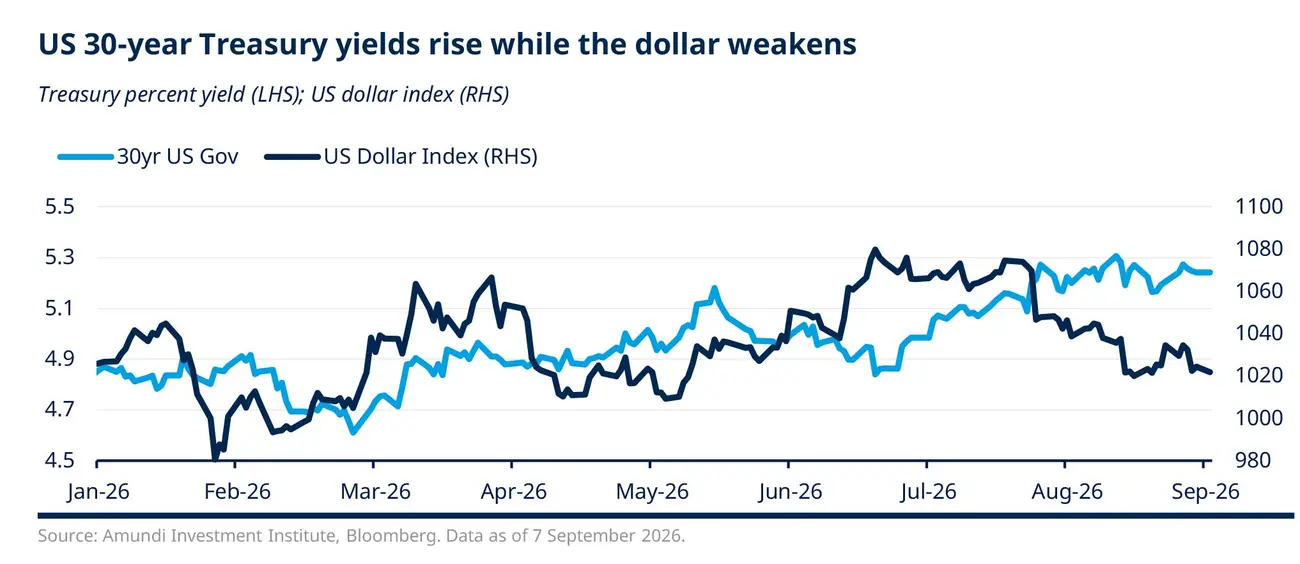
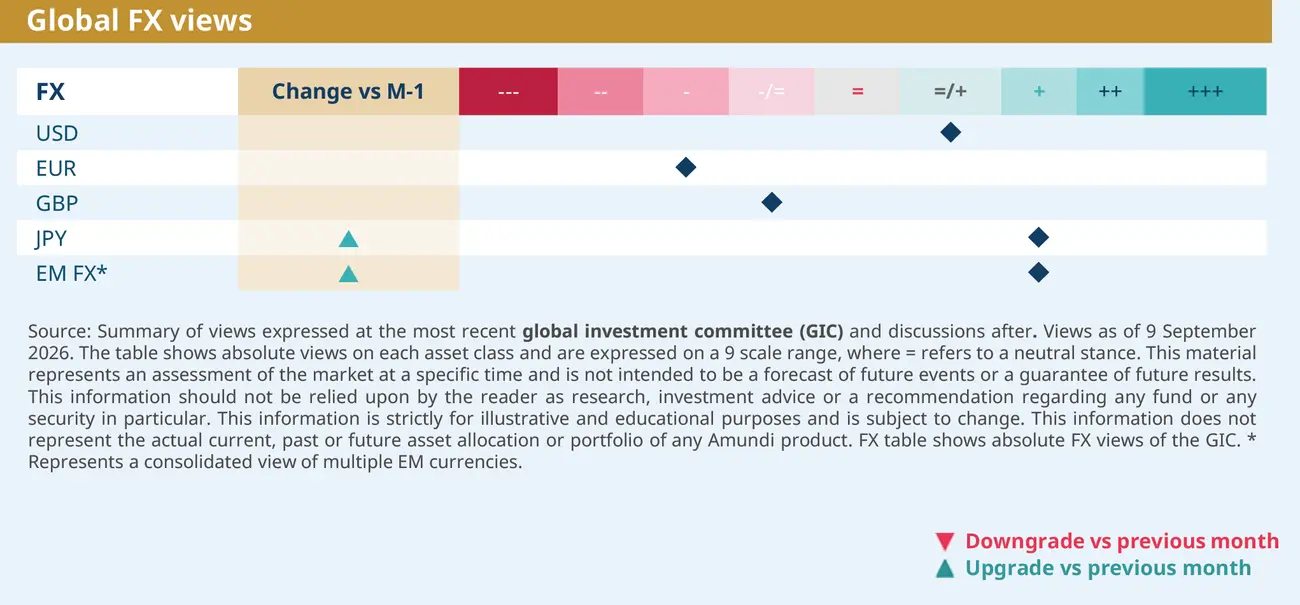
In the US, 30-year Treasury yields reached their highest level in almost two decades, resulting in the Treasury’s announcement of a double buyback programme. This action, together with the joint US Treasury–BoJ intervention in the yen, has reinvigorated the debasement trade, pushing the US dollar lower against other major currencies and highlighting the role of gold as a store of value.
With growing investor scrutiny of policymakers’ credibility and corporate leverage, we focus on the following main themes:
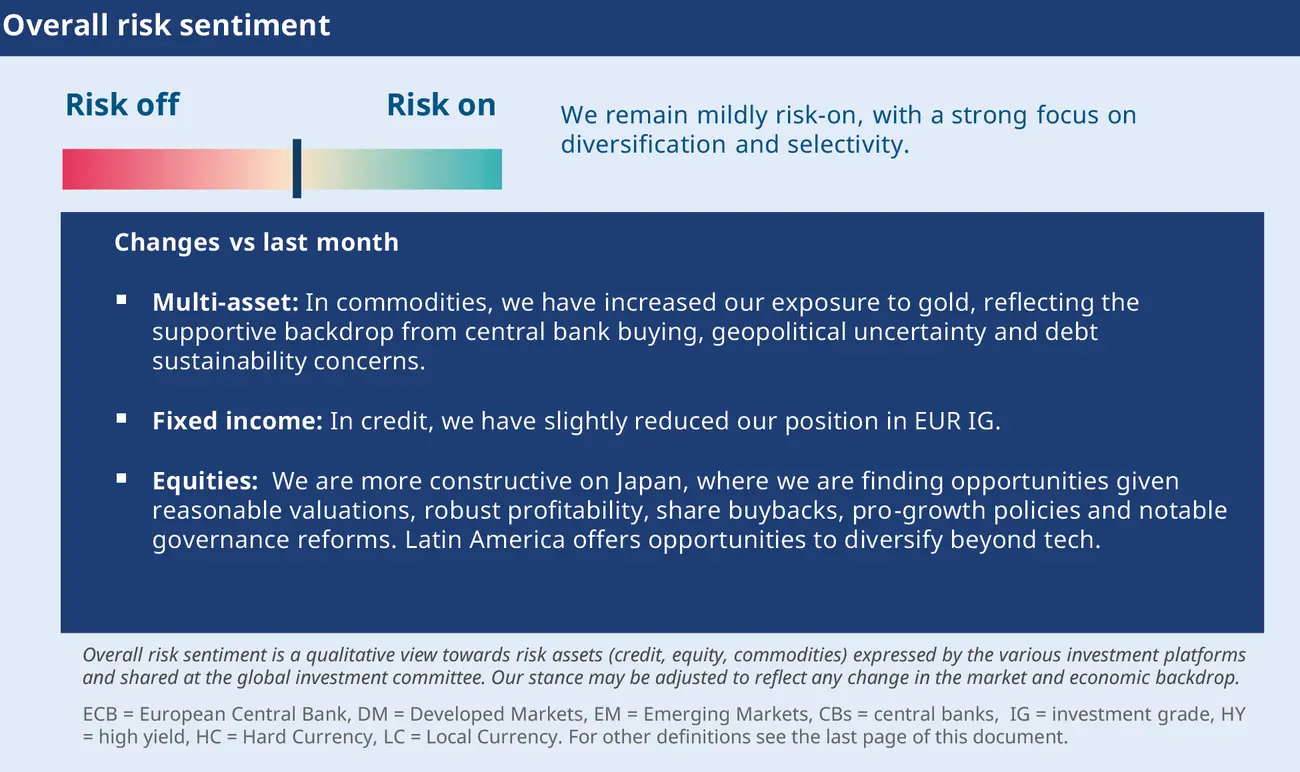
In this environment, we maintain a mildly risk-on stance overall, as the broader economic environment remains moderately constructive as long as credit and liquidity conditions remain benign. However, as risks build beneath the surface, we believe diversification is now more important than ever.
Amundi Investment Institute: Central bank actions
Fed: At Jackson Hole, Warsh struck an overall hawkish tone and a commitment to price stability without signalling an imminent hike or providing a policy threshold. The important message is a higher hurdle for cuts, and a higher-for-longer bias, with tightening still possible should inflation reaccelerate. The speech confirmed little appetite for alternative views on what matters most for the Fed and limited space for forward guidance. Short-term interest rates are set to remain the dominant tool, with unconventional tools to play only a limited role.
BoJ: Acknowledging upside inflation risks, the BoJ is likely to squeeze in four hikes before mid-2027, raising the policy rate to a neutral 2%. This is a regime change compared to its previous gradual normalisation, accelerated by the increased pressure on a weak yen.

Below we have outlined our views on asset classes in our current base-case scenario:
FIXED INCOME
Bond yields on the rise
Amaury D’ORSAY
Head of Fixed Income
Global growth remains resilient but uneven, with policy divergence and geopolitical tensions creating an increasingly fragmented macro environment. Oil price volatility over the summer, driven largely by geopolitical developments, has renewed uncertainty around the inflation trajectory and, by extension, the path of monetary policy. These factors, together with funding needs and a lack of fiscal discipline, have created tensions in longer dated bond markets globally.
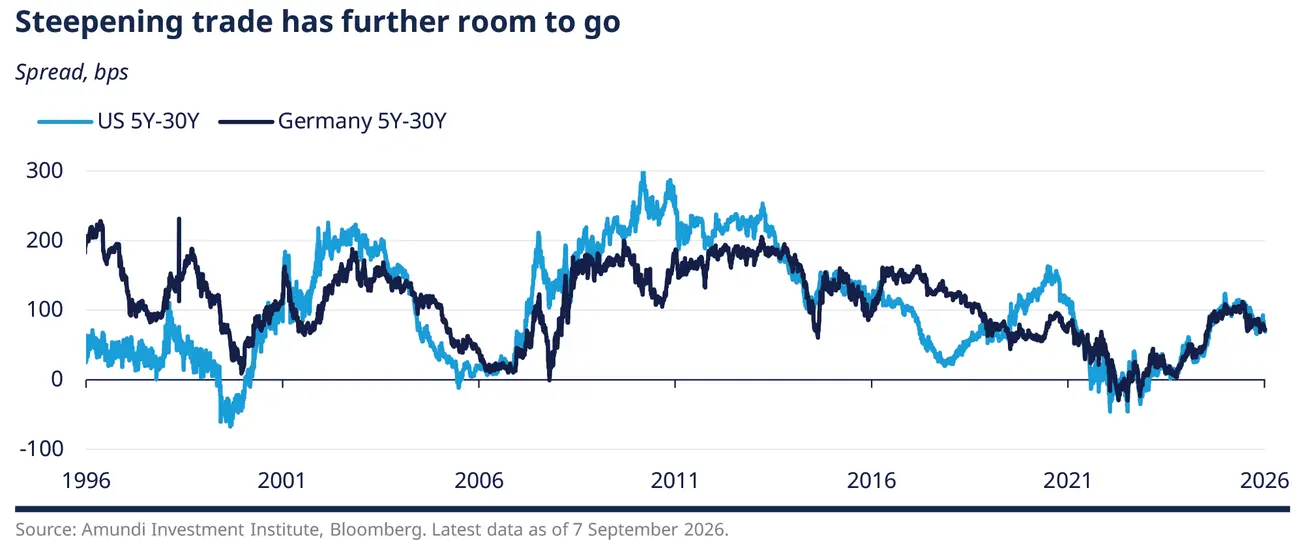
Even so, this does not materially change our view. We confirm our more dovish outlook for the Fed, expecting it to remain on hold through year-end, and for the ECB, where we continue to expect only one further hike. As pressure at the long end is likely to remain, this supports our conviction in curve steepening across the curves, except for Japan.
Duration and yield curves
Credit
EM bonds and FX
EQUITIES
Positioning for growth amid dispersion
Barry GLAVIN
Head of Equity Platform
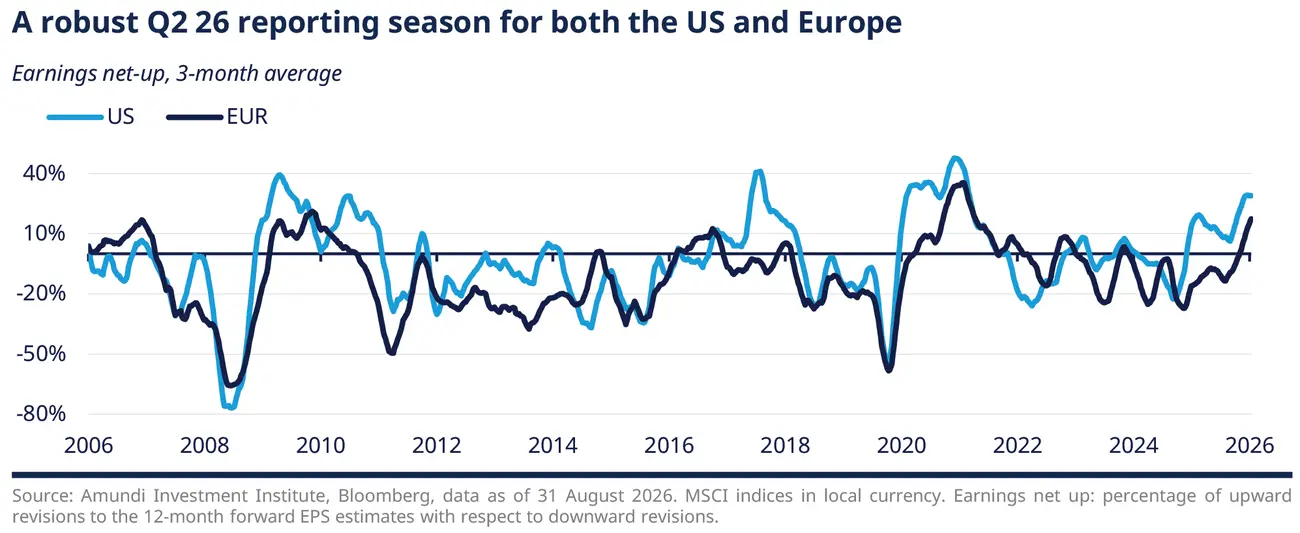
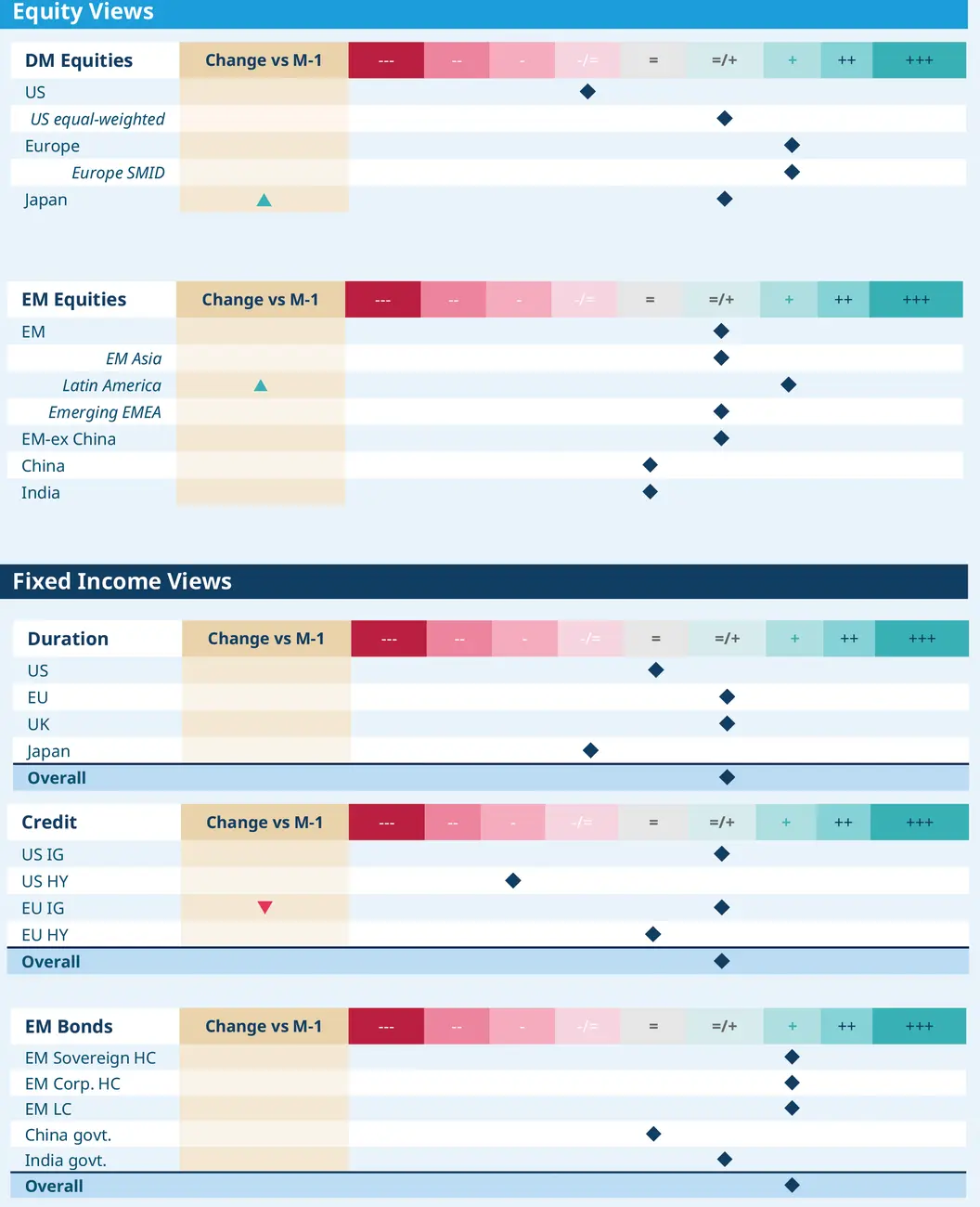
Equity markets edged higher, led by Europe and emerging markets. Earnings growth remains solid on both sides of the Atlantic. The earnings season highlighted wide single-stock dispersion, with investors rewarding growth and punishing misses. It has also delivered strong upgrades. As a result, earnings revisions have risen to levels usually seen during recovery phases. Also in EM, earnings remain robust.
We continue to diversify away from the U.S. to reduce concentration and valuation risks. Europe looks attractive on earnings growth and the drive toward strategic autonomy. In Japan, we are finding opportunities given robust profitability, share buybacks, pro-growth policies and notable governance reforms. We remain constructive on EM, while noting the importance of AI capex momentum for equity indices.
Developed Markets
Emerging Markets
MULTI-ASSET
Mildly pro-risk, with selectivity
Francesco SANDRINI
CIO Italy & Global Head of Multi-Asset
John O’TOOLE
Global Head - CIO Solutions
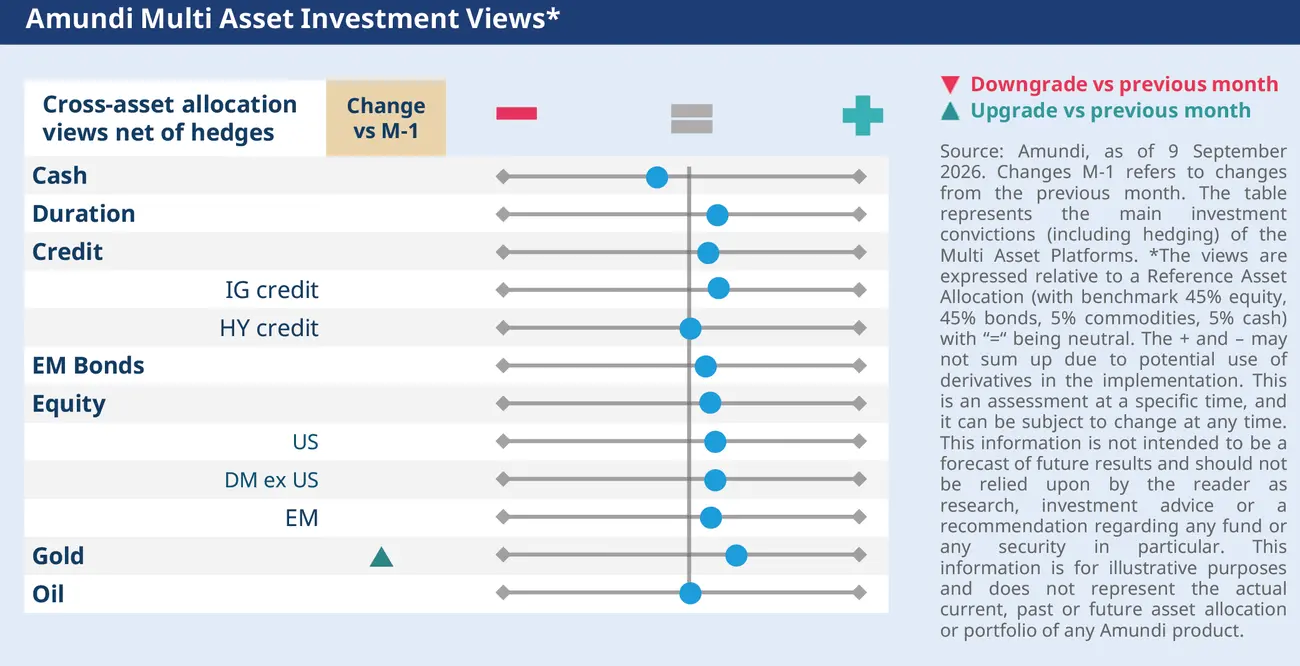
The broader economic environment remains moderately constructive, as growth has so far proven resilient, particularly in Europe, and inflation has given some signs of easing. As markets continue to be sensitive to any signs of renewed geopolitical or inflationary pressure, we confirm a pro-risk positioning, but with a clear preference for carry, selectivity and regional diversification.
On equities, we confirm a diversified approach as we continue to prefer areas with more supportive valuations and less risk concentration. In the US, we maintain a balanced stance through the S&P 500 Equal Weight alongside an even allocation to the S&P 500. In Europe, we confirm a positive stance. Valuations remain attractive, positioning is still light and the policy backdrop is supportive. We continue to see scope for a cyclical recovery, with banks and other cyclical sectors looking well placed. In emerging markets, Latin America also remains attractive with interesting valuations relative to other emerging markets.
In fixed income, we retain a constructive duration bias in the US and Europe. However, pressure at the long end has led us to adopt a more defensive view on the US curve, with a new steepening bias. We remain cautious on Japan. In credit, we maintain a constructive stance on Euro IG credit, given the still-attractive relative valuations and the potential for spreads to remain stable or compress further, whilst monitoring liquidity conditions closely. We also confirm a positive view on EM spreads, which continue to offer attractive carry and benefit from supportive market sentiment.
In commodities, we have increased our positive stance on gold: Central bank buying is still strong, while geopolitical uncertainty, debt sustainability concerns and a softer dollar continue to underpin structural demand.
In FX, we favour higher-carry EM currencies, with BRL and TRY still offering attractive carry.
VIEWS
Amundi views by asset classes
IMPORTANT INFORMATION
The MSCI information may only be used for your internal use, may not be reproduced or disseminated in any form and may not be used as a basis for or a component of any financial instruments or products or indices. None of the MSCI information is intended to constitute investment advice or a recommendation to make (or refrain from making) any kind of investment decision and may not be relied on as such. Historical data and analysis should not be taken as an indication or guarantee of any future performance analysis, forecast or prediction. The MSCI information is provided on an “as is” basis and the user of this information assumes the entire risk of any use made of this information. MSCI, each of its affiliates and each other person involved in or related to compiling, computing or creating any MSCI information (collectively, the “MSCI Parties”) expressly disclaims all warranties (including, without limitation, any warranty of originality, accuracy, completeness, timeliness, non-infringement, merchantability and fitness for a particular purpose) with respect to this information. Without limiting any of the foregoing, in no event shall any MSCI Party have any liability for any direct, indirect, special, incidental, punitive, consequential (including, without limitation, lost profits) or any other damages. (www.mscibarra.com).
The Global Industry Classification Standard (GICS) SM was developed by and is the exclusive property and a service mark of Standard & Poor's and MSCI. Neither Standard & Poor's, MSCI nor any other party involved in making or compiling any GICS classifications makes any express or implied warranties or representations with respect to such standard or classification (or the results to be obtained by the use thereof), and all such parties hereby expressly disclaim all warranties of originality, accuracy, completeness, merchantability or fitness for a particular purpose with respect to any of such standard or classification. Without limiting any of the forgoing, in no event shall Standard & Poor's, MSCI, any of their affiliates or any third party involved in making or compiling any GICS classification have any liability for any direct, indirect, special, punitive, consequential or any other damages (including lost profits) even if notified of the possibility of such damages.
This document is solely for informational purposes. This document does not constitute an offer to sell, a solicitation of an offer to buy, or a recommendation of any security or any other product or service. Any securities, products, or services referenced may not be registered for sale with the relevant authority in your jurisdiction and may not be regulated or supervised by any governmental or similar authority in your jurisdiction. The information contained in this document must not be altered or presented in a way that could give rise to misunderstanding or misrepresentation. Any use, reproduction, or distribution of the document’s content without full and proper reference to the original source is prohibited. Any information contained in this document may not be used as a basis for or a component of any financial instruments or products or indices. Furthermore, nothing in this document is intended to provide tax, legal, or investment advice. Unless otherwise stated, all information contained in this document is from Amundi Asset Management S.A.S. and is as of 9 September 2026. Diversification does not guarantee a profit or protect against a loss. This document is provided on an “as is” basis and the user of this information assumes the entire risk of any use made of this information. Historical data and analysis should not be taken as an indication or guarantee of any future performance analysis, forecast or prediction. The views expressed regarding market and economic trends are those of the author and not necessarily Amundi Asset Management S.A.S. or Amundi-Acba Asset Management CJSC and are subject to change at any time based on market and other conditions, and there can be no assurance that countries, markets or sectors will perform as expected. These views should not be relied upon as investment advice, a security recommendation, or as an indication of trading for any Amundi or Amundi-Acba product. Investment involves risks, including market, political, liquidity and currency risks. Furthermore, in no event shall Amundi or Amundi-Acba have any liability for any direct, indirect, special, incidental, punitive, consequential (including, without limitation, lost profits) or any other damages due to its use.
Date of first use: 9 September 2026.
"AMUNDI-ACBA ASSET MANAGEMENT" CJSC is a legal entity registered in Armenia, who, based on the Investment fund management license number 0002, provided by the Central Bank of Armenia, carries out mandatory pension fund management activities in Armenia. The registered office is located 10 Vazgen Sargsyan street, Premises 100-101, Yerevan, Armenia.
For more information about Amundi-Acba you can visit www.amundi-acba.am or call 011-310-000.