


 12.10.2026
 Read Time:
20 minutes
Read Time:
20 minutes




Central banks and AI in the driving seat
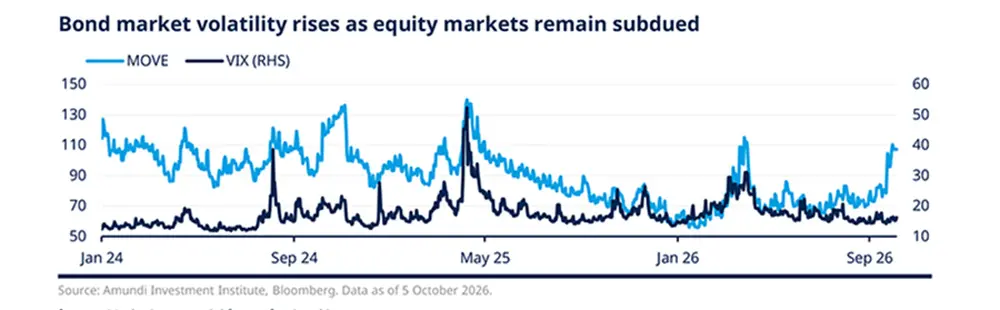
In September, global bond markets came under pressure amid inflation concerns and hawkish shifts by central banks, while equity markets remained relatively calm, supported by strong economic data and earnings, alongside renewed optimism around AI.
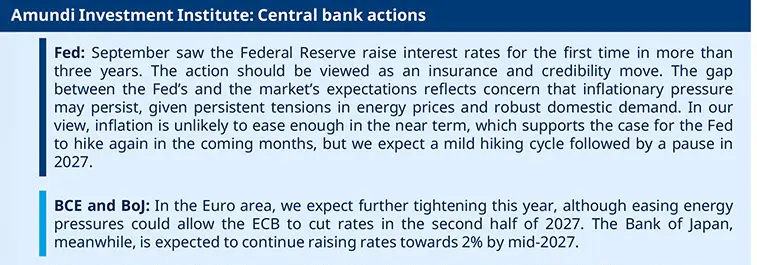
In fixed income, the average yield on global government debt has moved close to 4% – its highest level since 2007. Central bank tightening and hawkish tone increased expectations for further rate hikes, pushing the short end of the curve higher and flattening yield curves. Rising funding needs among governments and corporates are also keeping long-end yields elevated.
Oil prices remain news-flow driven. Brent rose to $105 before easing towards $90. Understanding whether rerouting efforts in the Middle East will be sufficient is becoming increasingly important for commodity markets.
Equity markets proved less volatile, as higher-rate headwinds were partially offset by renewed optimism on AI-theme for new product launches, continued infrastructure spending and positive earnings data.
Looking ahead, we focus on the following themes:
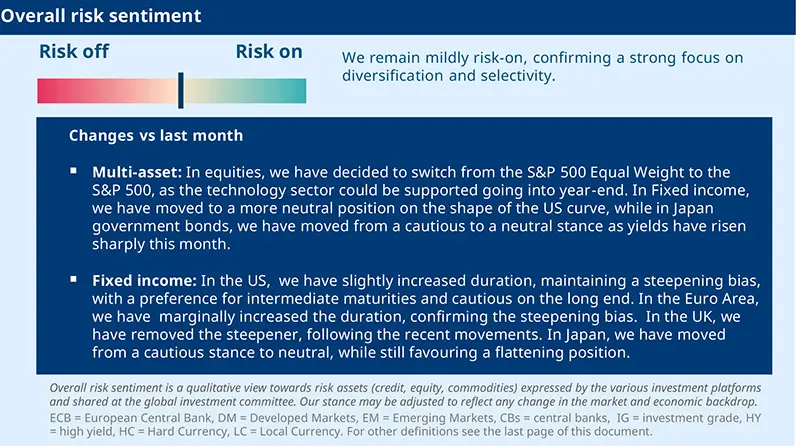
In this environment, we maintain a strong focus on diversification and selectivity within a mildly risk-on stance overall.

Below we have outlined our views on asset classes:
FIXED INCOME
More nuanced positioning
Amaury D’ORSAY
Head of Fixed Income
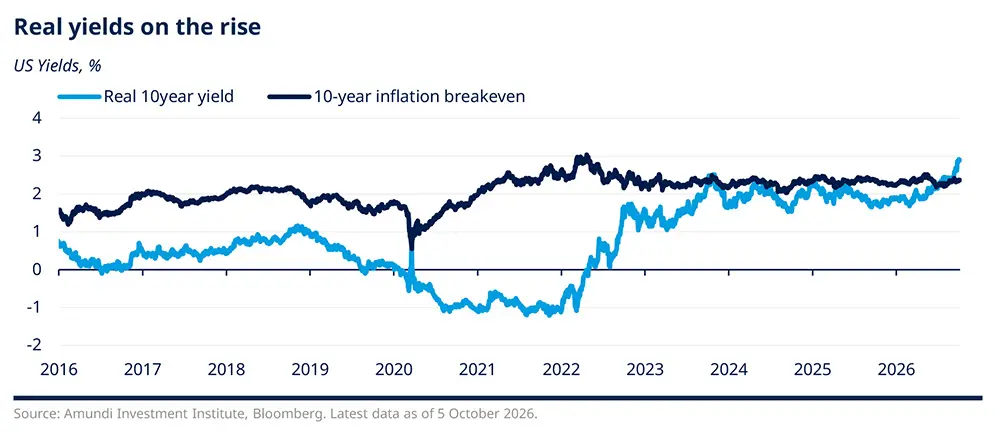
September saw major central banks take action. After a period of hawkish rhetoric, the Fed finally rose rates, alongside similar moves by the ECB and the Bank of Japan. Markets reacted by lifting interest rate expectations and pushing up short-term rates. On top of this, the long end continued to come under pressure amid economic resilience and issuance pressures, which have pushed real rates to attractive levels.
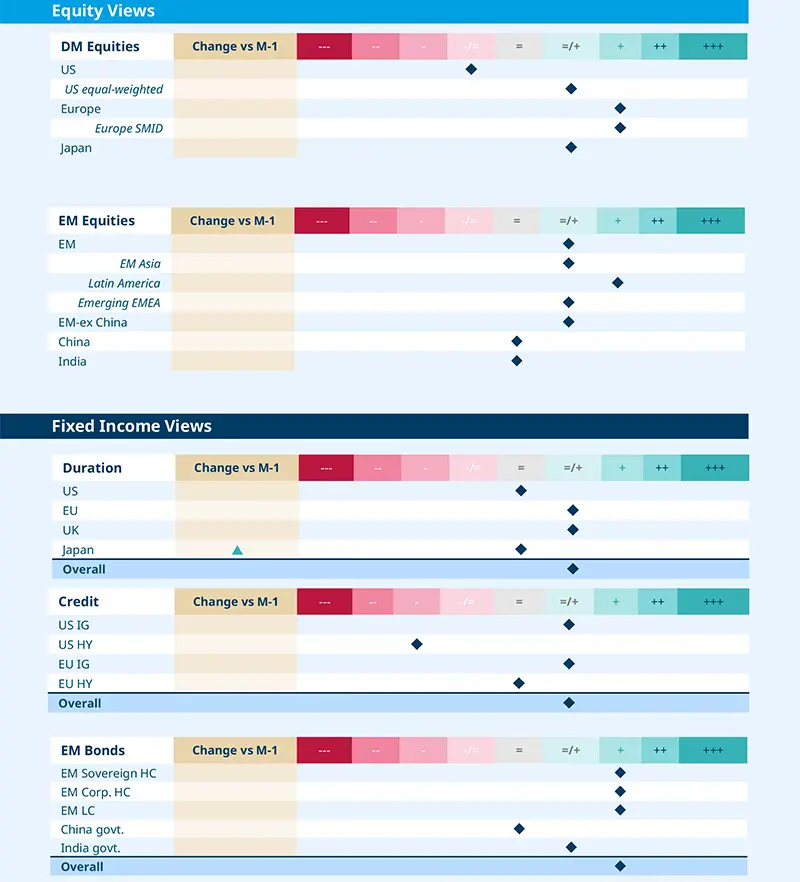
Looking ahead, we remain selectively constructive on duration, preferring short-to medium term maturity bonds while remaining cautious on the long end.
Duration and yield curves
Credit
EM bonds and FX
EQUITIES
Earnings support equity opportunities
Barry GLAVIN
Head of Equity Platform
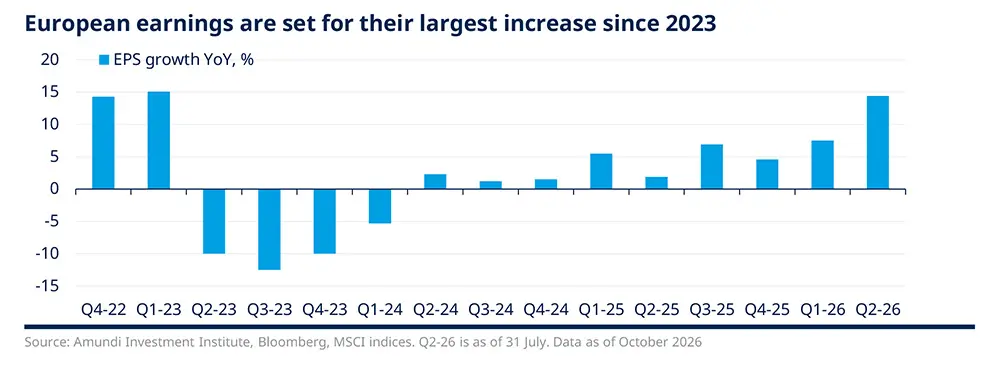
Equity markets were resilient amid hawkish central bank actions, inflation fears and rising bond yields. Indeed, these factors were partly offset by renewed enthusiasm on AI. Looking ahead, as earnings remain strong, the key question is how far equity valuations could be compressed in a rising-yield environment. Hence, our focus is on resilient, non-disrupted business models with balance sheet strength.
Across regions, we continue to favour areas outside the US as they offer lower concentration and valuation risks. Europe looks attractive relative to the US on earnings momentum, valuation and diversification. We remain positive on Japan, given robust earnings growth and reasonable valuations. EM offer opportunities to diversify across different themes, including energy, technology and structural demand drivers.
Developed Markets
Emerging Markets
MULTI-ASSET
Diversification, selection and carry
Francesco SANDRINI
CIO Italy & Global Head of Multi-Asset
John O’TOOLE
Global Head - CIO Solutions
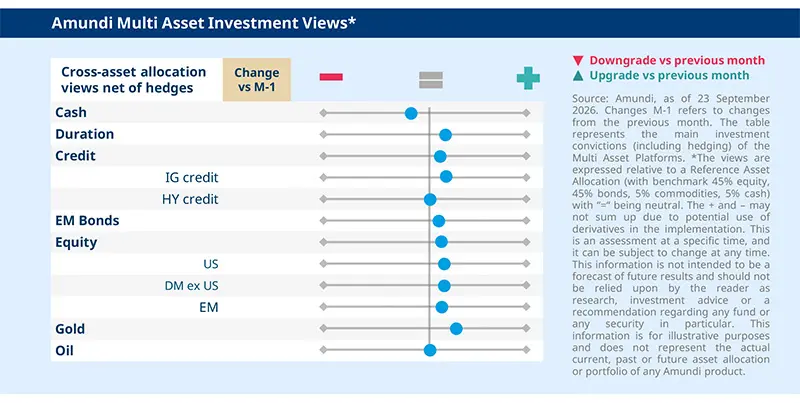
The broader macro view remains mildly pro-risk, with a preference for regional diversification, selectivity and carry. While growth remains resilient but uneven, inflation appears more persistent and is starting to look more broad-based. Central banks are reacting to this, with markets beginning to price in more rate hikes.
In fixed income, we retain a constructive duration bias in the US and euro area, as rates are becoming more attractive in absolute terms and the market seems to be pricing in too many central bank hikes. In the US, we maintain a preference for the intermediate part of the curve, as the market appears to be pricing in too many Fed hikes, but we have moved to a more neutral position on curve shape, removing the steepening bias for risk management purposes. In Japan, we have moved from a cautious to a neutral stance, as yields have risen sharply this month. Finally, we remain constructive on euro IG credit and confirm our positive view on EM bonds.
On equities, we maintain a constructive view. In the US, we have decided to switch from the S&P 500 Equal Weight Index to the S&P 500, as the technology sector could remain supported into year-end.
In commodities, we maintain a positive stance. While recent moves have been driven primarily by shifting expectations around Fed policy and rising yields, several supportive factors remain in place over the medium to long term, including expansionary fiscal policies, debt sustainability concerns and reserve diversification.
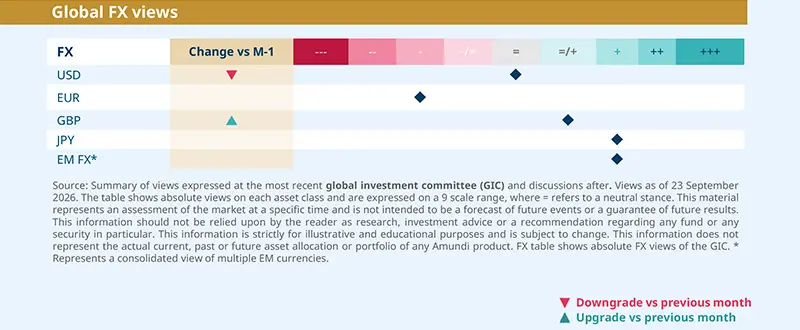
In FX, overall, we have a cautious stance on the USD and a preference for currencies that offer attractive carry, such as AUD and NOK among G10 currencies, and TRY among EM currencies.
VIEWS
Amundi views by asset classes
IMPORTANT INFORMATION
The MSCI information may only be used for your internal use, may not be reproduced or disseminated in any form and may not be used as a basis for or a component of any financial instruments or products or indices. None of the MSCI information is intended to constitute investment advice or a recommendation to make (or refrain from making) any kind of investment decision and may not be relied on as such. Historical data and analysis should not be taken as an indication or guarantee of any future performance analysis, forecast or prediction. The MSCI information is provided on an “as is” basis and the user of this information assumes the entire risk of any use made of this information. MSCI, each of its affiliates and each other person involved in or related to compiling, computing or creating any MSCI information (collectively, the “MSCI Parties”) expressly disclaims all warranties (including, without limitation, any warranty of originality, accuracy, completeness, timeliness, non-infringement, merchantability and fitness for a particular purpose) with respect to this information. Without limiting any of the foregoing, in no event shall any MSCI Party have any liability for any direct, indirect, special, incidental, punitive, consequential (including, without limitation, lost profits) or any other damages. (www.mscibarra.com).
The Global Industry Classification Standard (GICS) SM was developed by and is the exclusive property and a service mark of Standard & Poor's and MSCI. Neither Standard & Poor's, MSCI nor any other party involved in making or compiling any GICS classifications makes any express or implied warranties or representations with respect to such standard or classification (or the results to be obtained by the use thereof), and all such parties hereby expressly disclaim all warranties of originality, accuracy, completeness, merchantability or fitness for a particular purpose with respect to any of such standard or classification. Without limiting any of the forgoing, in no event shall Standard & Poor's, MSCI, any of their affiliates or any third party involved in making or compiling any GICS classification have any liability for any direct, indirect, special, punitive, consequential or any other damages (including lost profits) even if notified of the possibility of such damages.
This document is solely for informational purposes. This document does not constitute an offer to sell, a solicitation of an offer to buy, or a recommendation of any security or any other product or service. Any securities, products, or services referenced may not be registered for sale with the relevant authority in your jurisdiction and may not be regulated or supervised by any governmental or similar authority in your jurisdiction. The information contained in this document must not be altered or presented in a way that could give rise to misunderstanding or misrepresentation. Any use, reproduction, or distribution of the document’s content without full and proper reference to the original source is prohibited. Any information contained in this document may not be used as a basis for or a component of any financial instruments or products or indices. Furthermore, nothing in this document is intended to provide tax, legal, or investment advice. Unless otherwise stated, all information contained in this document is from Amundi Asset Management S.A.S. and is as of 5 October 2026. Diversification does not guarantee a profit or protect against a loss. This document is provided on an “as is” basis and the user of this information assumes the entire risk of any use made of this information. Historical data and analysis should not be taken as an indication or guarantee of any future performance analysis, forecast or prediction. The views expressed regarding market and economic trends are those of the author and not necessarily Amundi Asset Management S.A.S. or Amundi-Acba Asset Management CJSC and are subject to change at any time based on market and other conditions, and there can be no assurance that countries, markets or sectors will perform as expected. These views should not be relied upon as investment advice, a security recommendation, or as an indication of trading for any Amundi or Amundi-Acba product. Investment involves risks, including market, political, liquidity and currency risks. Furthermore, in no event shall Amundi or Amundi-Acba have any liability for any direct, indirect, special, incidental, punitive, consequential (including, without limitation, lost profits) or any other damages due to its use.
Date of first use: 5 October 2026.
"AMUNDI-ACBA ASSET MANAGEMENT" CJSC is a legal entity registered in Armenia, who, based on the Investment fund management license number 0002, provided by the Central Bank of Armenia, carries out mandatory pension fund management activities in Armenia. The registered office is located 10 Vazgen Sargsyan street, Premises 100-101, Yerevan, Armenia.
For more information about Amundi-Acba you can visit www.amundi-acba.am or call 011-310-000.