12.11.2026
 Read Time:
20 minutes




Shifts to quality and scarcity
Recent weeks have seen a reassessment of risks across energy markets, fiscal space, artificial intelligence-related (AI) stocks and emerging markets. Investors are increasingly favouring businesses with strong balance sheets, pricing power and exposure to structural supply constraints. In energy markets, the geopolitical premium appears more apparent, reflecting tighter and more expensive supply routes, rather than a temporary disruption. Although energy prices have retraced, this premium is likely to stay for some time.
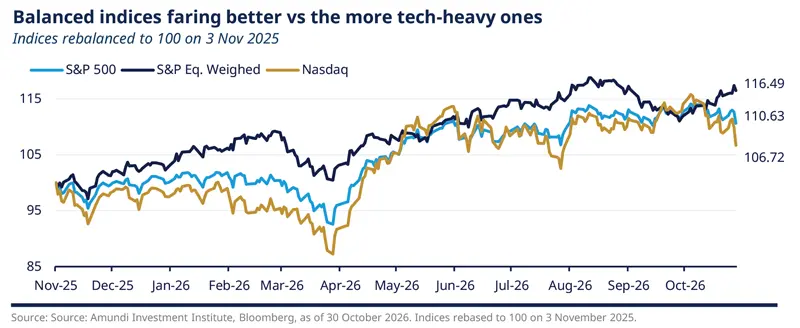
In equities, we are witnessing a rotation out of AI-related stocks. Markets are scrutinising the earnings potential and cash flows from the massive capital expenditure on AI. In addition, the Democratic sweep in the mid-term elections has raised concerns about closer examination of AI, Big Tech and data-centre development.
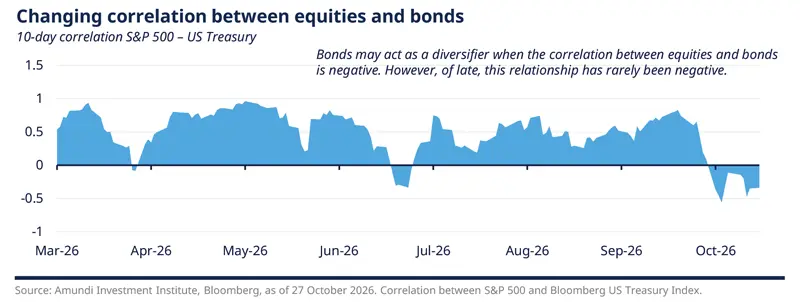
Government bond yields initially rose to levels not seen in years, but Treasuries eventually regained their safe-haven appeal. Core European bonds also benefited from a flight to quality.
This could, however, change, particularly amid a growing market focus on energy prices, monetary and fiscal policy, and the evolution of the AI narrative. We discuss these points below:
Amundi Investment Institute: Building portfolios that adapt to a changing world
Portfolio construction guidelines: In a supply-driven environment, where supply constraints matter more than demand, investors should focus on scarce assets. Many commodities markets are likely to remain structurally undersupplied. In equities, this includes scarce resources such as rare earths, as well as sectors linked to supply constraints, such as AI infrastructure, defence, aerospace and energy. In bonds, preference should be given to countries with low debt-to-GDP ratios, given the risk of oversupply in more indebted economies.

Below we have outlined our views on asset classes:
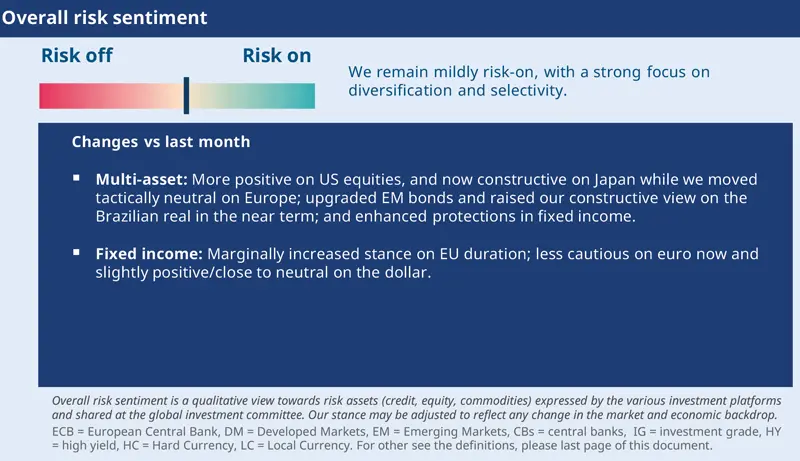
Overall, we maintain a mildly risk-on stance, with an emphasis on diversification and selectivity amid volatility, while paying close attention to portfolio construction.
FIXED INCOME
Constructive and flexible amid high rates
Amaury D’ORSAY
Head of Fixed Income
Resilient economic data on both sides of the Atlantic keep the macro backdrop constructive, but sticky inflation and elevated energy prices make the path of oil and gas the key variable for rates. In the US, the Fed remained on hold in October but still has accommodation to withdraw. The central bank’s patience should not be mistaken for complacency. The ECB also held rates steady amid higher energy prices, and tighter financial conditions, leaving the door open to further action.
Looking ahead, we remain constructive on duration, albeit selectively, and continue to prefer short- to medium-maturity bonds over the long end.
Duration and yield curves
Credit
EQUITIES
A balanced approach in volatile times
Barry GLAVIN
Head of Equity Platform
Global economic momentum has remained resilient, but fragilities persist. Concerns over heavy AI spending, sticky inflation and persistent geopolitical risks are some factors likely to shape trends in corporate earnings. This has led to higher volatility in rates and is affecting equities. In this environment, we aim to generate higher long-term returns through fundamental, bottom-up analysis.
We are avoiding expensive tech mega-caps, preferring to remain balanced. We favour markets such as Europe and Japan, which offer better risk-adjusted returns. While we favour EM over DM, returns are becoming increasingly selective, supporting the case for idiosyncratic opportunities.
Developed Markets
Emerging Markets
MULTI-ASSET
Rotation supported by earnings strength
Francesco SANDRINI
CIO Italy & Global Head of Multi-Asset
John O’TOOLE
Global Head - CIO Solutions
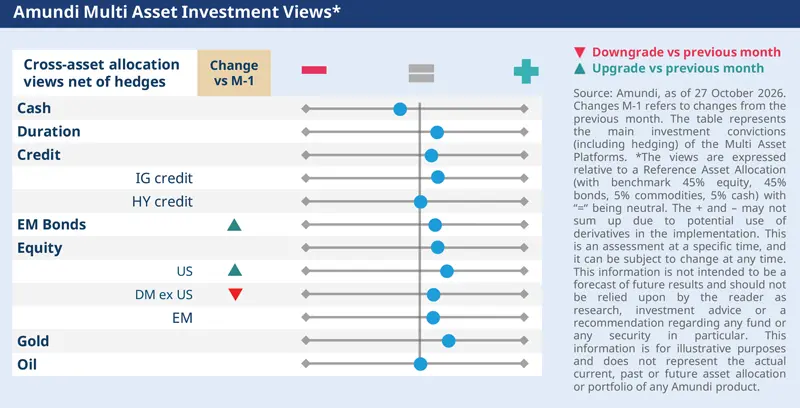
The economic backdrop remains resilient, with growth holding up despite higher rates, sticky inflation and geopolitical uncertainty. Markets have repriced aggressively, particularly in rates, while credit spreads have widened. Although liquidity conditions have modestly deteriorated, they remain benign. We maintain a moderately pro-risk stance by remaining selective and seizing tactical opportunities created by excessive market moves. We have balanced this by adding protection in asset classes such as European bonds, which may be more susceptible to near-term newsflow.
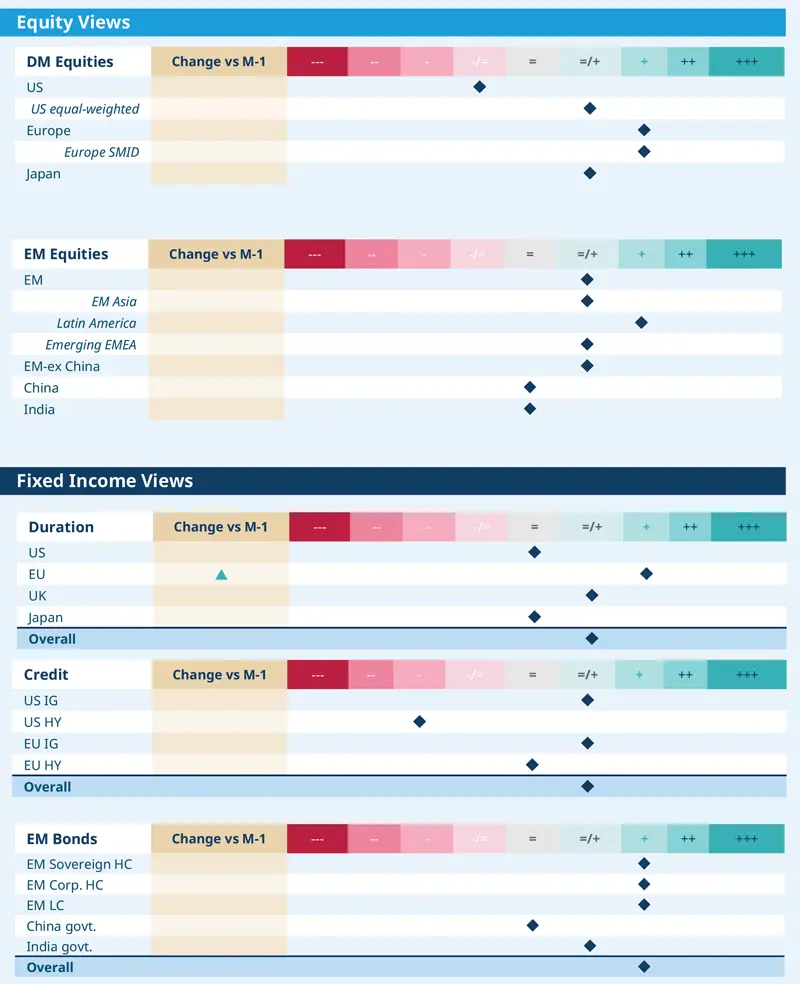
In equities, while our overall views have not changed, we see opportunities to rotate away from Europe (downgraded to neutral) toward the US (upgraded) and Japan (upgraded). We believe the US could continue to perform if earnings and capex remain supportive, while Japan offers a more diversified sector mix than Europe, with less direct exposure to financials. We see a strong long-term case for Europe. while in EM, our stance is positive on LatAm.
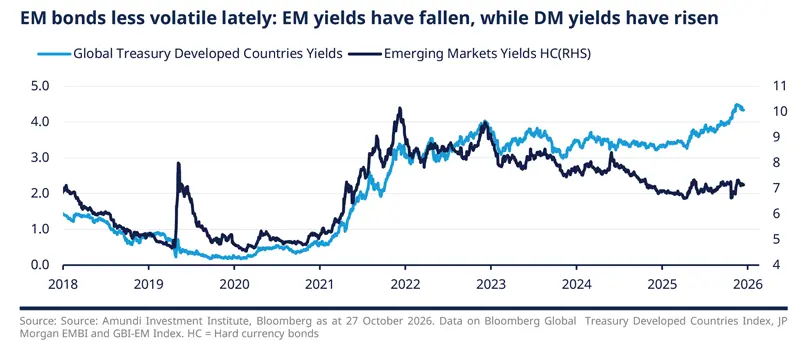
We retain a constructive duration view in the US and Europe (Schatz and Bunds). We also like Italian BTPs, given the country’s fiscal deficit trajectory and strong domestic demand. EU IG credit is another area where underlying fundamentals remain strong. Elsewhere, EM bonds offer attractive carry and, we have upgraded our view. We are now constructive on a select group of local bonds following recent market moves and have turned more optimistic on EM spreads.
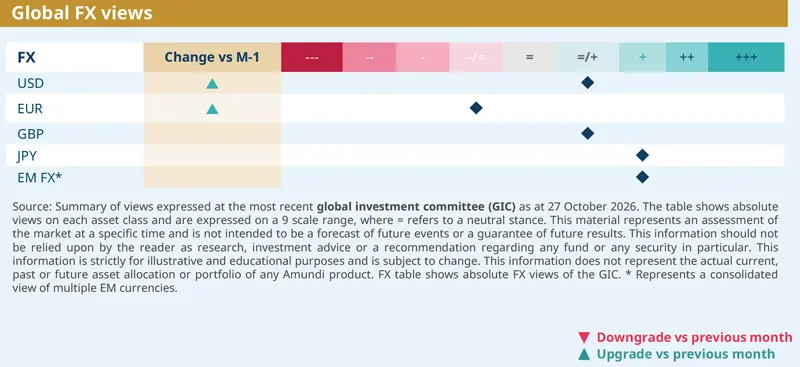
In FX, we are slightly cautious on the USD, but constructive on select EM FX, which offer attractive carry. In particular, we have turned more positive on BRL in the near term after the recent repricing. Finally, we now see potential for hedges in euro bonds and remain positive on gold.
VIEWS
Amundi views by asset classes
IMPORTANT INFORMATION
The MSCI information may only be used for your internal use, may not be reproduced or disseminated in any form and may not be used as a basis for or a component of any financial instruments or products or indices. None of the MSCI information is intended to constitute investment advice or a recommendation to make (or refrain from making) any kind of investment decision and may not be relied on as such. Historical data and analysis should not be taken as an indication or guarantee of any future performance analysis, forecast or prediction. The MSCI information is provided on an “as is” basis and the user of this information assumes the entire risk of any use made of this information. MSCI, each of its affiliates and each other person involved in or related to compiling, computing or creating any MSCI information (collectively, the “MSCI Parties”) expressly disclaims all warranties (including, without limitation, any warranty of originality, accuracy, completeness, timeliness, non-infringement, merchantability and fitness for a particular purpose) with respect to this information. Without limiting any of the foregoing, in no event shall any MSCI Party have any liability for any direct, indirect, special, incidental, punitive, consequential (including, without limitation, lost profits) or any other damages. (www.mscibarra.com).
The Global Industry Classification Standard (GICS) SM was developed by and is the exclusive property and a service mark of Standard & Poor's and MSCI. Neither Standard & Poor's, MSCI nor any other party involved in making or compiling any GICS classifications makes any express or implied warranties or representations with respect to such standard or classification (or the results to be obtained by the use thereof), and all such parties hereby expressly disclaim all warranties of originality, accuracy, completeness, merchantability or fitness for a particular purpose with respect to any of such standard or classification. Without limiting any of the forgoing, in no event shall Standard & Poor's, MSCI, any of their affiliates or any third party involved in making or compiling any GICS classification have any liability for any direct, indirect, special, punitive, consequential or any other damages (including lost profits) even if notified of the possibility of such damages.
This document is solely for informational purposes. This document does not constitute an offer to sell, a solicitation of an offer to buy, or a recommendation of any security or any other product or service. Any securities, products, or services referenced may not be registered for sale with the relevant authority in your jurisdiction and may not be regulated or supervised by any governmental or similar authority in your jurisdiction. The information contained in this document must not be altered or presented in a way that could give rise to misunderstanding or misrepresentation. Any use, reproduction, or distribution of the document’s content without full and proper reference to the original source is prohibited. Any information contained in this document may not be used as a basis for or a component of any financial instruments or products or indices. Furthermore, nothing in this document is intended to provide tax, legal, or investment advice. Unless otherwise stated, all information contained in this document is from Amundi Asset Management S.A.S. and is as of 6 November 2026. Diversification does not guarantee a profit or protect against a loss. This document is provided on an “as is” basis and the user of this information assumes the entire risk of any use made of this information. Historical data and analysis should not be taken as an indication or guarantee of any future performance analysis, forecast or prediction. The views expressed regarding market and economic trends are those of the author and not necessarily Amundi Asset Management S.A.S. or Amundi-Acba Asset Management CJSC and are subject to change at any time based on market and other conditions, and there can be no assurance that countries, markets or sectors will perform as expected. These views should not be relied upon as investment advice, a security recommendation, or as an indication of trading for any Amundi or Amundi-Acba product. Investment involves risks, including market, political, liquidity and currency risks. Furthermore, in no event shall Amundi or Amundi-Acba have any liability for any direct, indirect, special, incidental, punitive, consequential (including, without limitation, lost profits) or any other damages due to its use.
Date of first use: 6 November 2026.
"AMUNDI-ACBA ASSET MANAGEMENT" CJSC is a legal entity registered in Armenia, who, based on the Investment fund management license number 0002, provided by the Central Bank of Armenia, carries out mandatory pension fund management activities in Armenia. The registered office is located 10 Vazgen Sargsyan street, Premises 100-101, Yerevan, Armenia.
For more information about Amundi-Acba you can visit www.amundi-acba.am or call 011-310-000.