


 03.08.2026
 Read Time:
20 minutes
Read Time:
20 minutes




Prepare for rotations in concentrated and flow-driven markets
July saw tensions flare once again in the Middle East. Markets questioned the feasibility of returning to a ceasefire, pushing Brent oil prices back towards $100. Previously, prices had fallen to pre-war levels due to effective rerouting efforts and a reassessment of supply risks.
At the same time, an undercurrent of market rotations has been reshaping global equity markets. The move out of crowded trades has picked up as the market rebalances towards defensives, financials and industrials. As sector-specific drivers become more influential, performance has become more dispersed, reflected in low cross-sector correlation. In bond markets, yields rose to high levels, with initial scrutiny on fiscal space putting pressure on the long-end.
While investor sentiment remains supported by expectations for another strong earnings season, there is little room for disappointment, which could trigger faster rotations if results or guidance fall short. Liquidity remains supportive but may wane during the summer period; leverage in some tech names and crowded trades could also amplify market movements.
Looking ahead, our key convictions on oil prices, inflation, central bank action and markets are outlined below:

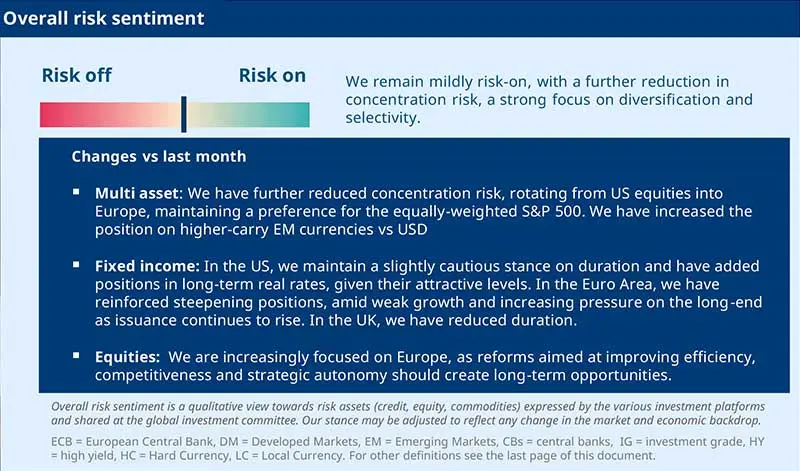
In this environment, we maintain a mild risk-on stance overall. We believe it is not time to add risk as rates are approaching high levels, earnings leave limited room for disappointment, and thinner summer liquidity could amplify market swings.
Amundi Investment Institute: Central banks’ framework post-Sintra Forum
Forward Guidance: The Fed has progressively moved away from forward guidance since 2018 towards a more data-dependent framework. However, reduced policy guidance by principal central banks may increase uncertainty over the short-rate path, creating additional volatility at the front end of the curve.
Yield curve movements. Looking ahead, we believe yield curve movements will be driven less by growth and more by monetary policy expectations, term-premium and fiscal vulnerabilities. High debt and deficits, as governments seek to finance strategic policy objectives, will require greater issuance, which markets will need to absorb. A shift in investor focus towards domestic bonds could therefore reshape bond market flows and determine the winners and losers in this race for high-quality yields.

In this environment, we confirm that diversification across regions and sectors is paramount to building a resilient portfolio, focusing on fundamentals and selectivity. Our convictions across asset classes are outlined below:
FIXED INCOME
Long-end rates reaching attractive value
Amaury D’ORSAY
Head of Fixed Income
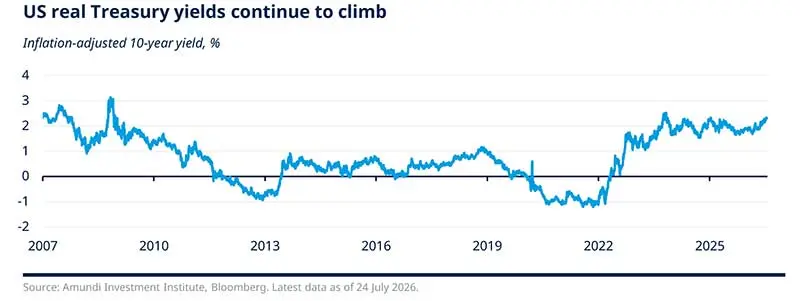
The macro backdrop remains mixed, with central banks remaining cautious, while inflation fears and monetary policy expectations are still being shaped by oil price dynamics. In the US, robust data and a relatively hawkish Fed are putting upward pressure on rates, supporting our cautious stance on duration, while also creating attractive opportunities in certain segments, such as the middle part of the curve and real rates.
In the Eurozone, the ECB appears to be fine-tuning its terminal rate, with any further moves likely to reflect calibration rather than a renewed tightening impulse. Pressure at the long end is likely to remain as issuance, net of ECB purchases, continues to rise. This supports our conviction in curve steepening, further reinforced after a period of flattening. In the UK, we slightly reduced the position, confirming the steepening amid weak growth and fiscal uncertainty.
Duration and yield curves
Credit
EM bonds and FX
EQUITIES
Focus on resilience and selectivity
Barry GLAVIN
Head of Equity Platform
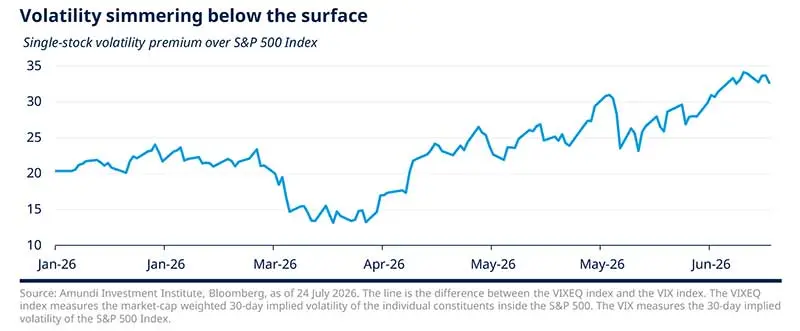
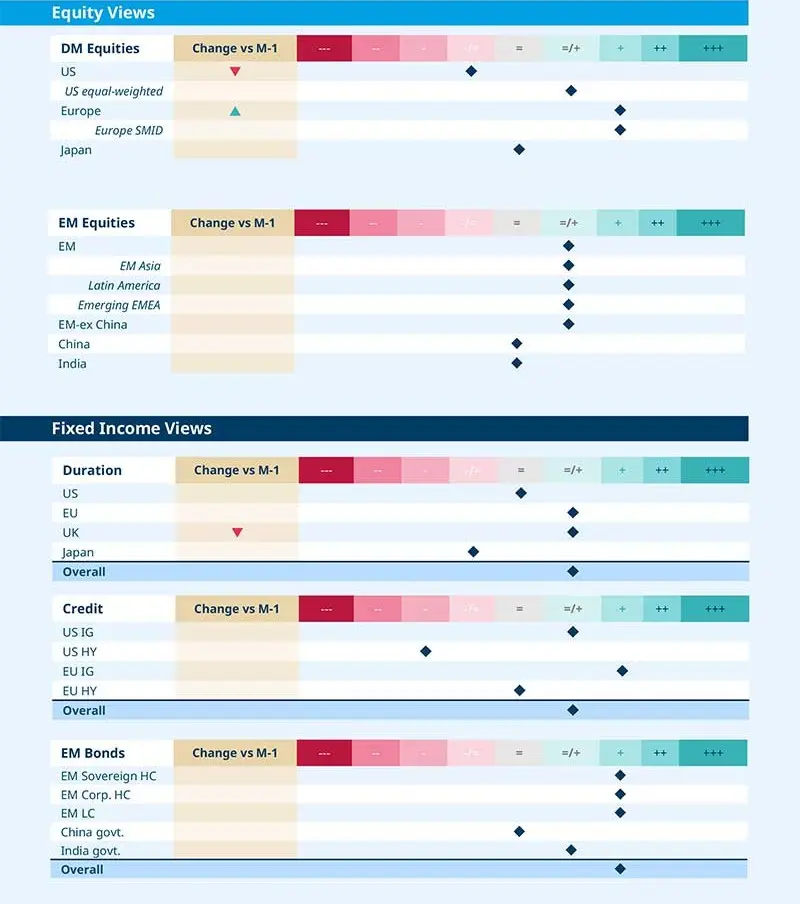
Recent weeks have shown that despite low market volatility, single-stock volatility is rising as investors increase scrutiny. Concerns over AI-related investments, profitability, valuations and supply chain risks remain in focus, reinforcing the importance of selectivity and structural resilience. Against this backdrop, we are strategically positioned away from the US, as concentration and valuation risks persist.
We confirm our long-term view on Europe, as reforms aimed at enhancing efficiency, competitiveness and strategic autonomy should support long-term opportunities. We are constructive on Japan, underpinned by solid fundamentals, pro-growth policies and valuations. Emerging Markets also look attractive, supported by technological strengths and valuations.
Developed Markets
Emerging Markets
MULTI-ASSET
Mildly pro-risk, with caution
Francesco SANDRINI
CIO Italy & Global Head of Multi-Asset
John O’TOOLE
Global Head - CIO Solutions
The overall macro backdrop remains supportive, yet inflation is sticky, central banks are still cautious, and growth continues to diverge across regions. In this context, we remain mildly pro-risk, focusing on carry, selectivity and diversification rather than strong directional conviction.
On equities, we remain constructive. However, in the US, the high concentration in a few names may lead to underperformance versus the rest of the world. As a result, we have tactically reduced our positive stance on the S&P 500 while maintaining a constructive view on the SPX Equally Weighted Index to participate in broad-based earnings growth momentum.
This rotation favours Europe, as the German reform package and infrastructure plans should provide a tailwind for the region. Moreover, the technical picture suggests that European equities are under-owned. We believe a rebound in European growth is possible in the second half of the year, with cyclical sectors, including banks, looking attractive.
In fixed income, we maintain a constructive duration view in the US and Europe, while remaining cautious on Japan, where the long end remains vulnerable to higher inflation, BoJ policy tightening and a rising term premium. We remain positive on 5-year US Treasuries, as softer labour data and subdued core CPI suggest the Fed may stay on hold longer than markets expect. In Europe, we maintain a positive stance on Bunds and Schatz, as markets now price only limited further ECB tightening and growth remains weak. BTPs continue to look attractive on carry. Finally, we remain constructive on EU IG credit, given attractive valuations, demand from yield buyers and positive seasonality, and on EM.
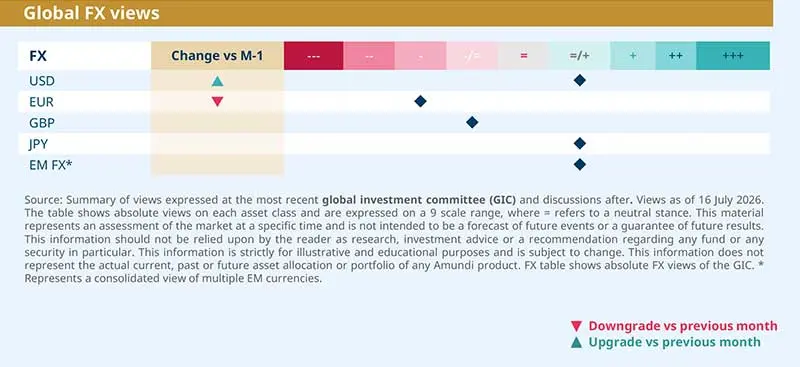
In FX, we continue to favour a rotation into higher-carry EM currencies vs USD, reducing the position on EUR vs USD. We favour the Brazilian real and Turkish lira because both are supported by improving fundamentals and attractive carry, with central banks expected to ease only cautiously.

VIEWS
Amundi views by asset classes
IMPORTANT INFORMATION
The MSCI information may only be used for your internal use, may not be reproduced or disseminated in any form and may not be used as a basis for or a component of any financial instruments or products or indices. None of the MSCI information is intended to constitute investment advice or a recommendation to make (or refrain from making) any kind of investment decision and may not be relied on as such. Historical data and analysis should not be taken as an indication or guarantee of any future performance analysis, forecast or prediction. The MSCI information is provided on an “as is” basis and the user of this information assumes the entire risk of any use made of this information. MSCI, each of its affiliates and each other person involved in or related to compiling, computing or creating any MSCI information (collectively, the “MSCI Parties”) expressly disclaims all warranties (including, without limitation, any warranty of originality, accuracy, completeness, timeliness, non-infringement, merchantability and fitness for a particular purpose) with respect to this information. Without limiting any of the foregoing, in no event shall any MSCI Party have any liability for any direct, indirect, special, incidental, punitive, consequential (including, without limitation, lost profits) or any other damages. (www.mscibarra.com).
The Global Industry Classification Standard (GICS) SM was developed by and is the exclusive property and a service mark of Standard & Poor's and MSCI. Neither Standard & Poor's, MSCI nor any other party involved in making or compiling any GICS classifications makes any express or implied warranties or representations with respect to such standard or classification (or the results to be obtained by the use thereof), and all such parties hereby expressly disclaim all warranties of originality, accuracy, completeness, merchantability or fitness for a particular purpose with respect to any of such standard or classification. Without limiting any of the forgoing, in no event shall Standard & Poor's, MSCI, any of their affiliates or any third party involved in making or compiling any GICS classification have any liability for any direct, indirect, special, punitive, consequential or any other damages (including lost profits) even if notified of the possibility of such damages.
This document is solely for informational purposes. This document does not constitute an offer to sell, a solicitation of an offer to buy, or a recommendation of any security or any other product or service. Any securities, products, or services referenced may not be registered for sale with the relevant authority in your jurisdiction and may not be regulated or supervised by any governmental or similar authority in your jurisdiction. The information contained in this document must not be altered or presented in a way that could give rise to misunderstanding or misrepresentation. Any use, reproduction, or distribution of the document’s content without full and proper reference to the original source is prohibited. Any information contained in this document may not be used as a basis for or a component of any financial instruments or products or indices. Furthermore, nothing in this document is intended to provide tax, legal, or investment advice. Unless otherwise stated, all information contained in this document is from Amundi Asset Management S.A.S. and is as of 27 July 2026. Diversification does not guarantee a profit or protect against a loss. This document is provided on an “as is” basis and the user of this information assumes the entire risk of any use made of this information. Historical data and analysis should not be taken as an indication or guarantee of any future performance analysis, forecast or prediction. The views expressed regarding market and economic trends are those of the author and not necessarily Amundi Asset Management S.A.S. or Amundi-Acba Asset Management CJSC and are subject to change at any time based on market and other conditions, and there can be no assurance that countries, markets or sectors will perform as expected. These views should not be relied upon as investment advice, a security recommendation, or as an indication of trading for any Amundi or Amundi-Acba product. Investment involves risks, including market, political, liquidity and currency risks. Furthermore, in no event shall Amundi or Amundi-Acba have any liability for any direct, indirect, special, incidental, punitive, consequential (including, without limitation, lost profits) or any other damages due to its use.
Date of first use: 27 July 2026.
"AMUNDI-ACBA ASSET MANAGEMENT" CJSC is a legal entity registered in Armenia, who, based on the Investment fund management license number 0002, provided by the Central Bank of Armenia, carries out mandatory pension fund management activities in Armenia. The registered office is located 10 Vazgen Sargsyan street, Premises 100-101, Yerevan, Armenia.
For more information about Amundi-Acba you can visit www.amundi-acba.am or call 011-310-000.