



 Read Time:
10 minutes
Read Time:
10 minutes



China: pressure before parley
Key takeaways
"Impacts of the trade war are just about to unfold, and some are not erasable by whimsical policy changes. It is complacent to assume there will be no structural consequence".
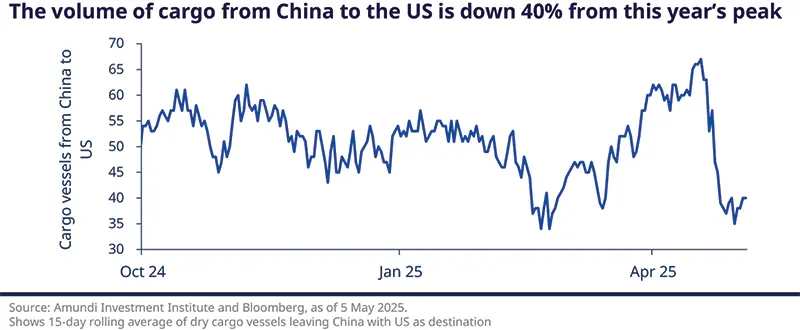
While mitigation plans may work for 30% tariffs, rates exceeding 100% are impossible to mitigate—even for businesses with high margins and strong pricing power. By imposing a high punitive tariff rate of 145%, Washington is dangerously flirting with the idea of economic decoupling. Even temporary adherence to this unsustainable rate has significant consequences.
The impacts are three-fold:
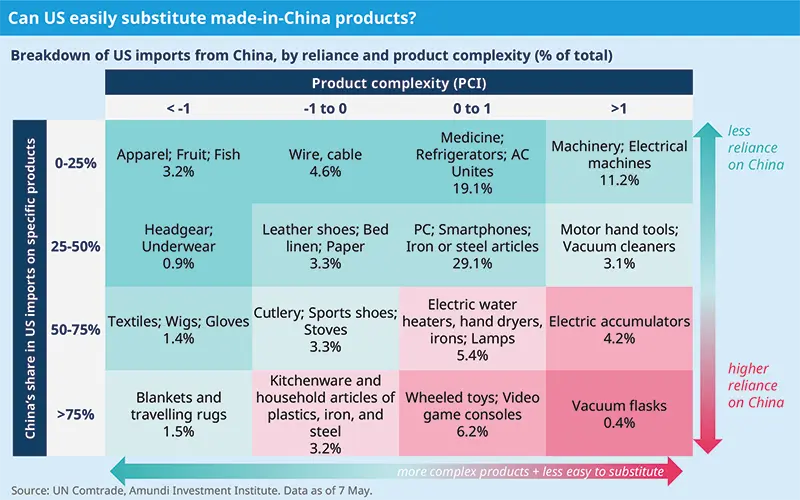
"Among the top 100 products that are hardest to substitute, China on average accounts for 57% of the world's total exports".
Mutual de-escalation happened quickly, allowing tariffs to fall from the highly-punitive 145% to 30%. Together with the initial tariffs under Trump’s first term, the effective US tariffs on Chinese imports are close to 40% - which are much higher vs Trum 1.0 and still prohibitive. Chinese exporters, on average operating with relatively low margins, have no effective way to mitigate the impacts on their own.
Mitigating amid multiple contingencies: amid the evolving tariff landscape, the bar for resuming monetary policy easing is lower compared to other measures. Rate cuts were already needed before Trump took office, to assist the fragile recovery in domestic demand. Restrictive US trade policies will act as a disinflationary demand shock to China’s economy, further worsening the existing deflation issue.
On 7 May, the PBoC cut the RRR by 50bp and the policy rate by 10bp. We expect two more cuts of 10bp each in July and September, respectively.
For fiscal policy, however, Chinese policymakers might prefer to wait and assess how damaging the trade war is before taking decisive action. It has only been two months since the fiscal stimulus package (approximately 2% of GDP) was introduced by the National People’s Congress.
Q3 will provide a good opportunity to evaluate the need for a supplementary budget, with May and June data available for a better assessment of the impacts.
Playing the long game, China has no time constraints in this fight, unlike Trump with the upcoming mid-term elections, allowing Beijing to adopt a strategic approach. China’s economic warfare arsenal comprises three arrays of tools:
1․ Offensive measures: these aim to retaliate and inflict pain on the rival, such as restricting access to critical Chinese supplies like rare earths (i.e., through its own export control), and gatekeeping access to China’s market (punitive retaliatory tariffs, regulatory investigations, and government procurement rules). Selling US Treasury holdings would be ineffective as an offensive market measure. Even if all of China’s FX reserves ($3.2 trillion) were invested in US Treasuries, the sheer size of the Treasury market— with daily trading volume exceeding $900bn—means China’s rapid liquidation would be absorbed within 3-4 days, limiting any lasting market impact. Not to mention that the Fed has multiple liquidity tools to mitigate Chinese selling pressures.
2․ Defensive measures: these are designed to mitigate the negative effects of potential attacks, particularly in the financial market, where the US holds a clear advantage in blocking China's access to the dollar-dominated global financial system. FX reserve divestments, cross-border payment arrangements, RMB settlement infrastructure, and central bank swap lines will progress further and faster.
3․ Remedial measures: these involve concessions and positive moves, such as re-engaging in negotiations with the US, deepening trade ties with US allies through multilateral agreements like the CPTPP and strengthening partnerships with the Global South. In this context, traditional tactical tools that could hurt strategic goals— export subsidies and currency devaluation—will likely be set aside.
Key take-aways on China’s equity market from the desk
We maintain a long-term positive view on China, considering the recent significant shift to supportive fiscal policies. However, given the extreme uncertainty on the tariff side, we are more cautious in the short term, and we think it's time to pivot towards more domestic and defensive areas that are less impacted by tariffs.
As such, we favour the onshore market (China A-shares) over offshore market (China H-shares) and domestic demand and dividend yield over export-oriented exposure, given the more geopolitically resilient risk premia in the onshore market and the government's focus on stimulating domestic demand.
In China, we are seeing positive momentum in earnings within the tech sector, particularly with the rise of AI applications and consumer technology. Nonetheless, we remain cautious about the risks of increasing overcapacity in China and the potential dumping or displacement of existing products in global markets, which would pose challenges for both domestic and international players.
NICHOLAS MCCONWAY, HEAD OF ASIA EX-JAPAN EQUITY, AMUNDI
US and China: managing a deteriorating relationship
Anna ROSENBERG
Head of Geopolitics, Amundi Investment Institute
Although trade tensions between the US and China have now eased, it is important to understand the broader dynamic between the two countries. Over the next few years, the US-China relationship will continue to deteriorate, with 2027 seen as a key date on the horizon. This is the year the US security establishment believes China could be in a position to militarily challenge the US. Whether or not this is accurate, these fears are driving US policy towards China as well as US efforts to re-industrialise. To wage and win wars, a country must have a solid industrial base to build and repair military equipment. Trump’s steel, aluminium and China tariffs must be seen from this perspective; they also aim at weakening China’s industrial capacity.
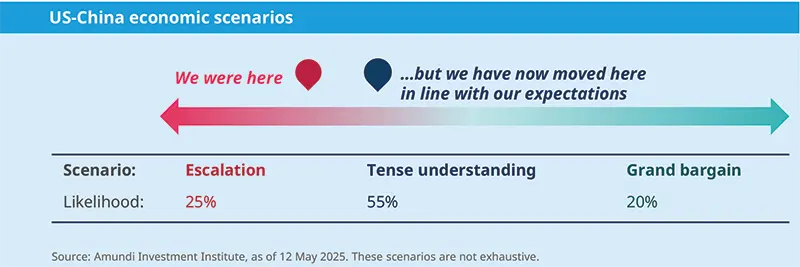
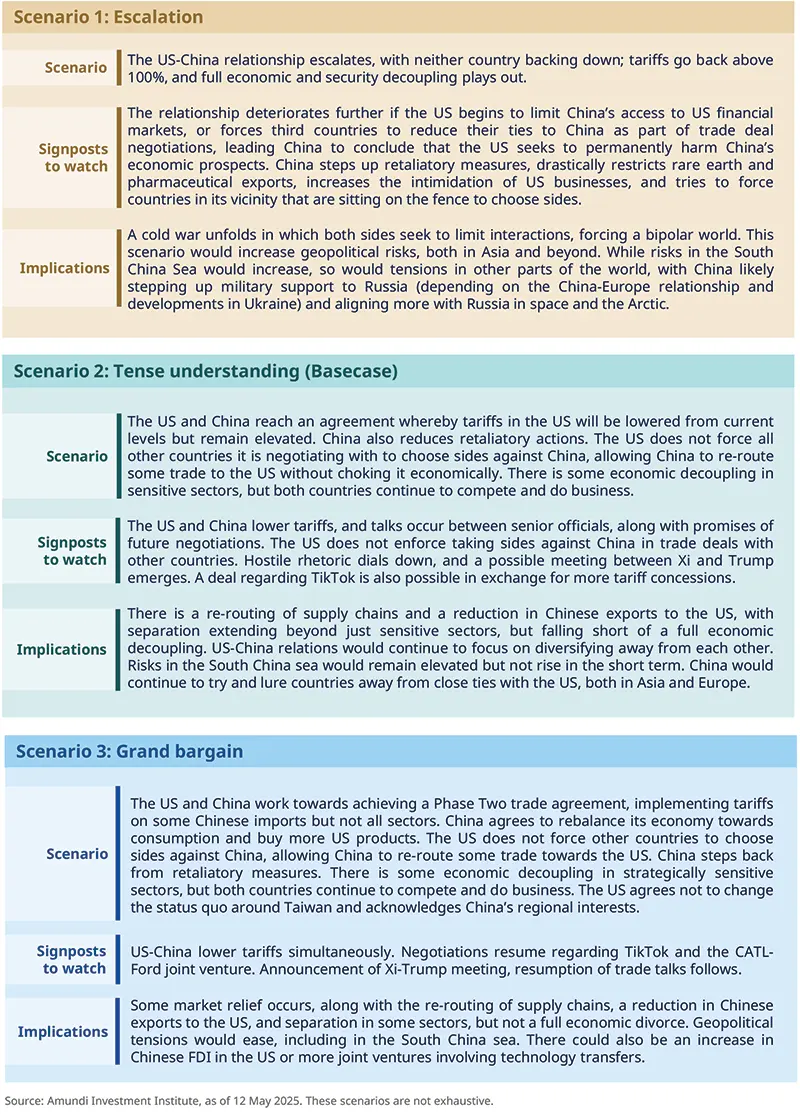
That being said, in 2025, the US and China have little interest in allowing their relationship to spiral out of control: it is about achieving a divorce that still allows both parties to remain economically afloat. We are now seeing both sides walk back on tariffs. The scenarios outlined below show how the relationship has evolved from the ‘escalation scenario’ to our basecase, the ‘tense understanding scenario’, in which we expected US-China tariffs to fall significantly from the previous 145% level. While further talks are possible, we do not expect a ‘grand bargain’ anytime soon. During Trump’s first term, US-China trade negotiations proved difficult and took years to complete.
"In 2025, the US and China have little interest in allowing their relationship to spiral out of control: it is more about achieving a divorce that still allows both parties to remain economically afloat".
IMPORTANT INFORMATION
The MSCI information may only be used for your internal use, may not be reproduced or disseminated in any form and may not be used as a basis for or a component of any financial instruments or products or indices. None of the MSCI information is intended to constitute investment advice or a recommendation to make (or refrain from making) any kind of investment decision and may not be relied on as such. Historical data and analysis should not be taken as an indication or guarantee of any future performance analysis, forecast or prediction. The MSCI information is provided on an “as is” basis and the user of this information assumes the entire risk of any use made of this information. MSCI, each of its affiliates and each other person involved in or related to compiling, computing or creating any MSCI information (collectively, the “MSCI Parties”) expressly disclaims all warranties (including, without limitation, any warranty of originality, accuracy, completeness, timeliness, non-infringement, merchantability and fitness for a particular purpose) with respect to this information. Without limiting any of the foregoing, in no event shall any MSCI Party have any liability for any direct, indirect, special, incidental, punitive, consequential (including, without limitation, lost profits) or any other damages. (www.mscibarra.com).
The Global Industry Classification Standard (GICS) SM was developed by and is the exclusive property and a service mark of Standard & Poor's and MSCI. Neither Standard & Poor's, MSCI nor any other party involved in making or compiling any GICS classifications makes any express or implied warranties or representations with respect to such standard or classification (or the results to be obtained by the use thereof), and all such parties hereby expressly disclaim all warranties of originality, accuracy, completeness, merchantability or fitness for a particular purpose with respect to any of such standard or classification. Without limiting any of the forgoing, in no event shall Standard & Poor's, MSCI, any of their affiliates or any third party involved in making or compiling any GICS classification have any liability for any direct, indirect, special, punitive, consequential or any other damages (including lost profits) even if notified of the possibility of such damages.
This document is solely for informational purposes. This document does not constitute an offer to sell, a solicitation of an offer to buy, or a recommendation of any security or any other product or service. Any securities, products, or services referenced may not be registered for sale with the relevant authority in your jurisdiction and may not be regulated or supervised by any governmental or similar authority in your jurisdiction. The information contained in this document must not be altered or presented in a way that could give rise to misunderstanding or misrepresentation. Any use, reproduction, or distribution of the document’s content without full and proper reference to the original source is prohibited. Any information contained in this document may not be used as a basis for or a component of any financial instruments or products or indices. Furthermore, nothing in this document is intended to provide tax, legal, or investment advice. Unless otherwise stated, all information contained in this document is from Amundi Asset Management S.A.S. and is as of 9 May 2025. Diversification does not guarantee a profit or protect against a loss. This document is provided on an “as is” basis and the user of this information assumes the entire risk of any use made of this information. Historical data and analysis should not be taken as an indication or guarantee of any future performance analysis, forecast or prediction. The views expressed regarding market and economic trends are those of the author and not necessarily Amundi Asset Management S.A.S. or Amundi-Acba Asset Management CJSC and are subject to change at any time based on market and other conditions, and there can be no assurance that countries, markets or sectors will perform as expected. These views should not be relied upon as investment advice, a security recommendation, or as an indication of trading for any Amundi or Amundi-Acba product. Investment involves risks, including market, political, liquidity and currency risks. Furthermore, in no event shall Amundi or Amundi-Acba have any liability for any direct, indirect, special, incidental, punitive, consequential (including, without limitation, lost profits) or any other damages due to its use.
Date of first use: 9 May 2025.
"AMUNDI-ACBA ASSET MANAGEMENT" CJSC is a legal entity registered in Armenia, who, based on the Investment fund management license number 0002, provided by the Central Bank of Armenia, carries out mandatory pension fund management activities in Armenia. The registered office is located 10 Vazgen Sargsyan street, Premises 100-101, Yerevan, Armenia.
For more information about Amundi-Acba you can visit www.amundi-acba.am or call 011-310-000.


